







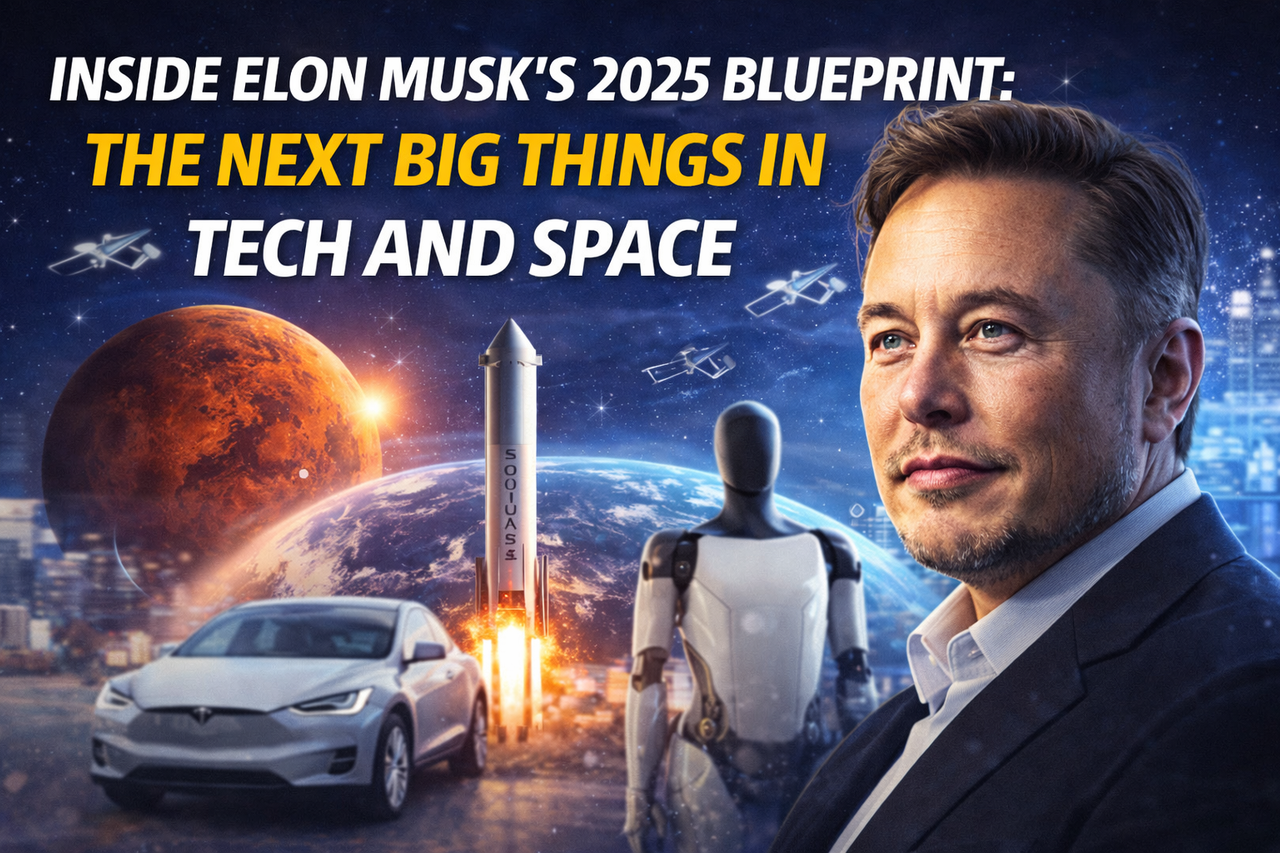




Elon Musk’s 2025 Vision: Projects That Could Change the World
Elon Musk’s 2025 vision focuses on AI, space exploration, clean energy, robotics, and global connectivity. Discover how his upcoming projects could reshape the future of humanity.
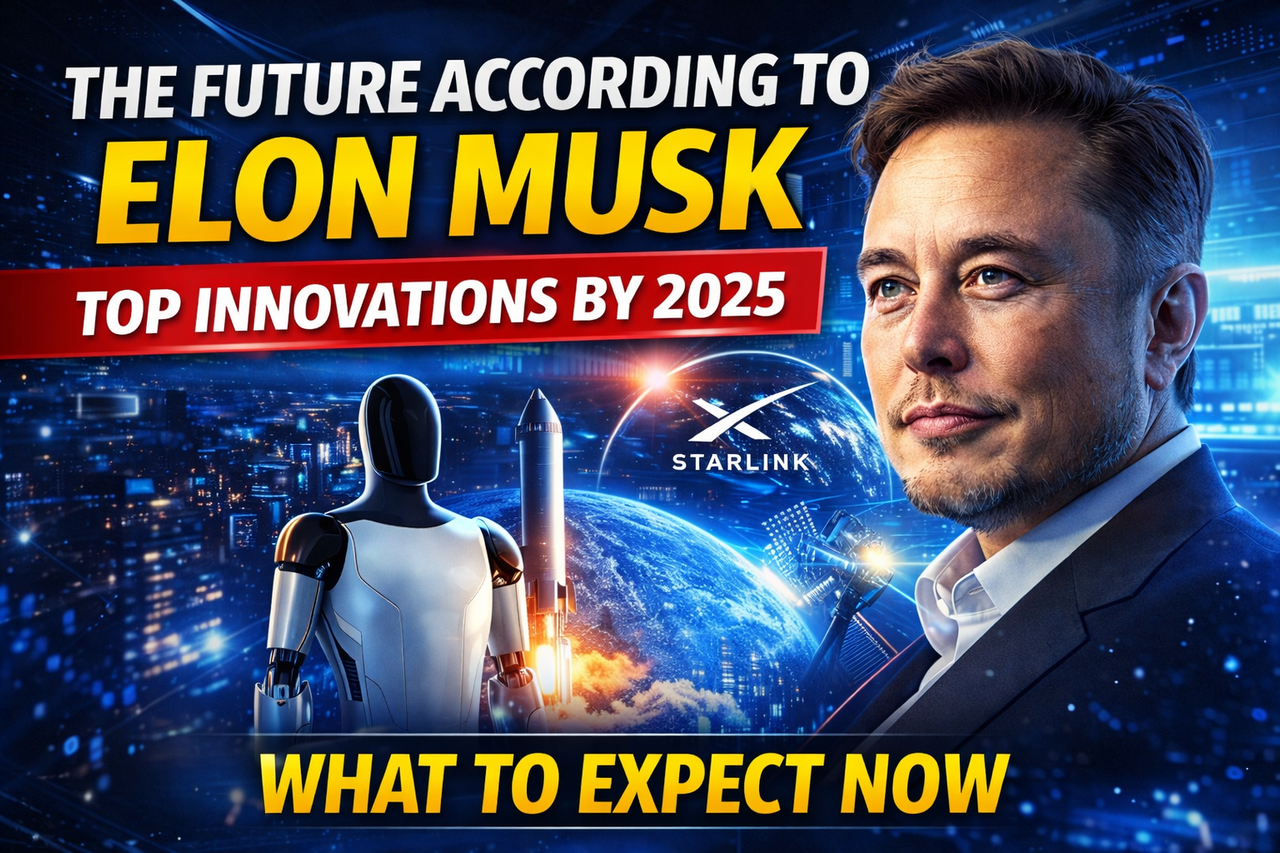
The Future According to Elon Musk: Top
Innovations to Watch by 2025
Elon Musk is not just a technology entrepreneur — he is a long-term thinker focused on how humanity will live and survive in the future. Many of his ideas once sounded unrealistic, yet over time they have turned into real products and global industries.
As 2025 approaches, Musk’s vision is becoming clearer than ever. His companies are not just experimenting — they are scaling technologies that may soon impact billions of people worldwide.
From artificial intelligence to clean energy and deep-space exploration, Musk’s mission is simple — solve problems that affect human life at a global level.
This article explores the most important innovations Elon Musk believes will shape the world by 2025 — and why they matter for all of us.
Table of Contents
- Artificial Intelligence and Automation
- Autonomous Transportation Systems
- Space Exploration and Mars Preparation
- Global Internet Connectivity
- Clean Energy and Sustainability
- Robotics and the Future of Work
- Human–Technology Integration
- Impact on Jobs and the Economy
- Impact on Society and Daily Life
- Key Takeaways
- FAQs
- Conclusion
Artificial Intelligence and Automation
Artificial intelligence is one of the strongest pillars of Elon Musk’s future vision. He believes AI will soon be deeply embedded into everyday tools and decision-making systems.
By 2025, AI is expected to move beyond basic automation and become more context-aware — meaning it will understand tasks, environments, and human intent better than ever.
Key AI Applications
- Self-driving vehicle intelligence
- Smart assistants for productivity
- AI-powered manufacturing
- Advanced data-driven analytics
However, Musk has often warned that AI must be used responsibly. Without safety frameworks, uncontrolled AI development could become risky — which is why he advocates strict regulation and ethical guidelines.
Autonomous Transportation Systems
Transportation is expected to evolve dramatically by 2025. Musk believes autonomous vehicles can reduce road accidents, fuel consumption, and human fatigue — making travel safer and smarter.
Self-driving systems are improving rapidly with millions of real-world driving hours and AI training.
Expected Benefits
- Fewer road accidents
- Lower transportation costs
- Smoother and faster traffic movement
Fully autonomous driving may still require time and regulation — but the foundations are already in place.
Space Exploration and Mars Preparation
Space exploration remains a core element of Musk’s long-term strategy. He believes humanity must expand beyond Earth to survive existential risks like climate disasters or asteroid collisions.
By 2025, major progress is expected in reusable rockets and interplanetary mission planning.
Key Space Goals
- Frequent reusable rocket launches
- Significant reduction in launch costs
- Testing and preparing Mars-ready systems
These steps will not immediately lead to colonization — but they will build the technology base required for the future.
Global Internet Connectivity
Reliable internet is still unavailable in many remote regions. Musk’s vision aims to connect the entire planet with high-speed satellite internet — empowering education, healthcare, and economic growth.
Why Connectivity Matters
- Remote education and e-learning
- Growth of digital entrepreneurship
- Better global communication
Universal connectivity means opportunities — especially for developing regions.
Clean Energy and Sustainability
Musk believes clean energy is the foundation of a sustainable future. Fossil fuels are finite — and their environmental damage is long-lasting.
His goal is to make renewable energy affordable and scalable across homes, industries, and transportation networks.
Clean Energy Focus Areas
- Advanced battery storage
- Large-scale solar power
- Electric vehicles and charging infrastructure
A transition to clean energy could significantly reduce pollution and support long-term sustainability.
Robotics and the Future of Work
Robotics is expected to transform industries by 2025. Musk sees robots as collaborative assistants — taking over dangerous or repetitive jobs while humans focus on creativity, problem-solving, and innovation.
Robotics Use Cases
- Manufacturing and assembly automation
- Warehouse logistics
- Support in elderly care and healthcare
Instead of replacing humans completely, robots are likely to augment human capability.
Human–Technology Integration
One of Musk’s most futuristic areas of development involves deeper interaction between the human brain and digital systems.
Health-focused technology could help restore lost mobility, treat brain disorders, and improve quality of life for millions of patients.
Potential Benefits
- Treatment for paralysis
- Management of neurological illnesses
- Improved brain–computer communication
This innovation is still in early stages — but progress is accelerating quickly.
Impact on Jobs and the Economy
Every technological revolution changes the job market. Musk believes innovation will reshape how people work — rather than eliminating employment entirely.
By 2025, many new job roles may exist that are not present today.
Economic Shifts
- Rapid growth in technology-based careers
- Decline in repetitive manual roles
- Higher demand for digital and analytical skills
Reskilling will become essential for long-term success in the workforce.
Impact on Society and Daily Life
Many of these innovations will integrate quietly into everyday routines. Homes, cars, workplaces, and cities may all become smarter — improving comfort, safety, and sustainability.
Everyday Life Changes
- Smarter and more connected homes
- Cleaner and quieter transportation
- Better access to online services
The change may feel gradual — but over time, daily life could look very different from today.
Key Takeaways
- Elon Musk’s vision focuses on long-term human progress
- AI, clean energy, and space exploration are central pillars
- Robotics and connectivity may redefine everyday life
- Responsible innovation is essential for safety and ethics
FAQs
1. What is Elon Musk’s main focus for 2025?
He focuses on artificial intelligence, clean energy, space exploration, global internet access, and sustainable technology.
2. Will AI replace human jobs?
Some roles may change — but new opportunities will emerge in tech-driven sectors.
3. Is Mars colonization planned by 2025?
No — 2025 focuses mainly on testing, research, and mission preparation rather than permanent settlement.
4. Why is clean energy important?
Clean energy reduces pollution and supports long-term environmental sustainability.
5. Are these innovations safe?
Safety depends on regulation, strong testing frameworks, and responsible development.
Conclusion
According to Elon Musk, the future by 2025 will be shaped by intelligent systems, renewable energy, automation, robotics, and bold space exploration. These innovations are not just technological advancements — they are stepping stones toward a safer, more sustainable, and more connected world.
Challenges will always exist — but with thoughtful planning and global cooperation, these ideas can turn into real progress. The next few years may define how humanity evolves alongside technology — shaping the future for generations to come.
What's Your Reaction?